


FishStrike: win real cash
4.71.57K Reviews
App Specs
- Version
- 1.3
- Updated On
- License
- Free
- Downloads
- 100,000+
- Developer
- Omarguanhs
- Categories
- Casual
- Platform
- Android
Screenshots




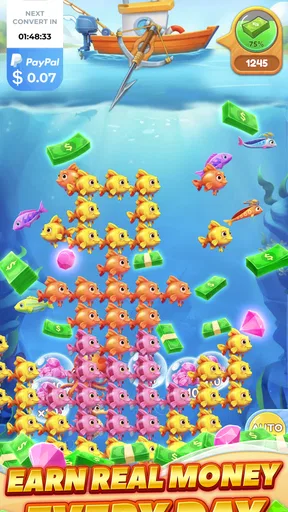
 Analysis by AppCompare
FishStrike is a casual fishing game built around a very simple promise: catch fish, build up diamonds, and return later to see whether those rewards can be exchanged for PayPal value. I spent time with it as the kind of game you open for a short break rather than a deep adventure, and that distinction matters. The appeal is not a large world, a complicated story, or a collection of demanding systems. It is the small loop of taking an action, seeing a result, working toward a reward, and deciding whether another session feels worthwhile.
That straightforward design makes it easy to understand almost immediately. I did not need a long tutorial or a complicated explanation before starting. At the same time, the reward angle changes how I judge the game. A normal casual fishing title can be enjoyable even when its progression is purely virtual. Here, the possibility of converting diamonds into real PayPal rewards every three hours creates a practical question: does the fishing itself remain pleasant when the reward process becomes the main reason to return?
FishStrike is free, is suitable for Everyone, and comes from Omarguanhs. It is available as a casual game rather than a serious fishing simulation, so I approached it as a light routine for spare moments. The current release is version 1.3 and it requires Android 9 or later. Those details make it most relevant to people using a reasonably modern Android phone who want something uncomplicated, but they do not automatically make it a good fit for every player.
How the FishStrike loop feels from the first tap to the next session
When I judge FishStrike from one visit to the next, I pay attention to more than whether the diamond balance rises: I ask whether the short fishing routine still feels like a break I chose, rather than a task I owe the game. That distinction helps set realistic expectations for the next part of the experience, where version history and the current release matter only insofar as they affect how existing players approach it.
The first action is deliberately easy to understand
The strongest part of the opening experience is how quickly the central action becomes clear. You fish, receive feedback, and watch your in-game balance develop. There is no need to learn a complicated control scheme before discovering whether the game suits you. For a casual title, that low entry barrier is important: I can imagine opening it while waiting for a bus, during a short break, or when I want interaction without committing to a long play session.
The first few actions also establish the game’s real personality. FishStrike is not trying to recreate the patience, equipment choices, and environmental detail of a full fishing simulator. Its fishing is a means to an end, with the end being progress toward diamonds and the possibility of a later reward. Players who want relaxing scenery, realistic casting, or a large catalogue of fishing locations may find the experience too narrow. Players who prefer immediate, repeatable actions will understand its appeal much faster.
I recommend treating the opening as a test rather than assuming the cash element will carry the whole game. Play long enough to see whether the basic action feels satisfying on its own. If tapping through the fishing cycle already feels like a chore before the reward system becomes relevant, the game is unlikely to improve for you later. The reward goal can add motivation, but it cannot replace enjoyable moment-to-moment interaction.
Worth Reading Before You Choose

EA SPORTS FC Mobile 26 Is a Bigger Football Game, but It Takes Time

Flipboard Shows What News Apps Must Do Beyond the Feed

Switching to Android Auto Means Rethinking Your Driving Routine

Google Calendar Makes a Crowded Week Easier to Manage

Ludo King Makes the Most of the Minutes Between Plans

Baby Panda World Brings Quick Play to Modern Phones, but Its Game Library Feels Busy
Feedback gives each short session a clear rhythm
The game’s feedback rhythm is built around visible progress. An action leads to a catch or another form of in-game response, the balance changes, and that change gives me a reason to continue. This is a familiar casual-game structure, but it works here because the steps are easy to follow. I am not trying to remember a complicated build, manage a team, or solve a puzzle before I can see whether the latest attempt mattered.
That rhythm is particularly useful for players who like small goals. Instead of asking myself to finish a large campaign, I can focus on making the next catch, increasing the diamond total, and checking whether I am closer to the reward stage. The game therefore fits short attention windows better than many progression-heavy alternatives. It is easy to stop after a brief run because the activity is naturally divided into repeated actions rather than one uninterrupted challenge.
There is a trade-off, though. Repetition becomes noticeable when the feedback does not introduce enough variety. A casual loop can be calming at first and monotonous later, especially if the player is continuing mainly because of the promised reward. I would not choose FishStrike for a long evening of uninterrupted play. Its better use is as a lightweight check-in game, where the repeated action has a place inside a daily routine instead of becoming the entire routine.
Diamonds are the point where play becomes a decision
The diamond balance gives the game a stronger sense of direction than a purely decorative fishing game. Each catch is connected to a visible objective, and that objective is more concrete than simply unlocking another cosmetic item. The store summary presents a route from diamonds to real PayPal rewards, with the conversion available every three hours. That schedule is central to how I would use the game: it encourages returning at a suitable time rather than expecting every short visit to produce an immediate payout.
My practical advice is to separate three ideas in your mind: playing, accumulating diamonds, and requesting or converting a reward. They are related, but they are not the same moment. The fishing action is the entertainment; the diamond total is the progress marker; the three-hour timing is part of the reward routine. Keeping those stages distinct makes the experience less frustrating because I am not judging every single catch as if it should instantly become money.
This is also where expectations need to stay realistic. FishStrike is free, and the cash-oriented goal may be attractive, but I would treat the PayPal element as a bonus objective rather than a dependable income source. A game that rewards spare-time interaction can be fun, yet it should not replace work, savings, or a financial plan. Anyone installing it mainly to earn meaningful money may be disappointed if the repeated fishing begins to feel larger than the value of the reward.
A useful personal workflow is to set a small play window, check the diamond progress, and then close the game instead of repeatedly reopening it without a purpose. Since the reward cycle is tied to a three-hour interval, returning at a planned time makes more sense than constantly checking. This is one of the less obvious ways to preserve the game’s casual character: let the timer shape your visits, not your entire day.
The three-hour reward cycle changes the best way to play
The reward timing creates a natural reset point. After a session, I am left with a choice: continue fishing immediately, or stop and return when the next reward window is relevant. That choice is more interesting than it sounds because it determines whether FishStrike feels like a relaxed break or a repetitive obligation. If I keep playing without a clear reason, the loop can lose its charm. If I stop with a specific return point in mind, the next session has a purpose.
For an everyday example, imagine opening the game during a morning coffee break. I can fish for a few minutes, note the diamond progress, and close it before starting work. Later, when the three-hour opportunity is relevant, I can decide whether to return during lunch or another free moment. That pattern suits the game far better than leaving it open for a long stretch while hoping that constant activity will transform the experience into something deeper.
The reset also helps reveal who should skip the game. If you dislike waiting between reward opportunities, prefer continuous progression, or want a game that respects every minute with new content, the three-hour structure may feel restrictive. A conventional arcade game would be a better choice for uninterrupted action. A traditional fishing game would suit someone who wants technique and atmosphere. FishStrike is for the player who accepts a modest loop and likes having a reason to come back later.
What the audience response suggests, and what it does not prove
FishStrike has reached more than one hundred thousand installs, with an average rating of 4.7 from around eighteen thousand ratings and roughly one and a half thousand written reviews. Those figures show that the basic concept has found an audience, and the rating indicates that many players respond positively to its accessible structure. I see that as a useful sign when deciding whether the game is worth a quick trial, especially because it is free to start.
Still, popularity cannot answer the most personal question: will you enjoy repeating the fishing action? Ratings often reflect the initial appeal of a simple reward loop, while long-term satisfaction depends on how comfortable you are with repetition and waiting. I would use the audience response as encouragement to try it, not as proof that the cash objective will match your expectations.
Where it sits beside other casual games
Compared with a standard idle game, FishStrike gives the progress loop a more concrete theme. Instead of watching a generic number rise, I am performing a fishing action and connecting that action to diamonds. Compared with a typical arcade game, it is less focused on reflexes and more focused on returning, accumulating, and timing the reward stage. Compared with a realistic fishing simulator, it is much lighter and less concerned with authenticity.
That middle position is both its strength and its limitation. It can be easier to approach than a simulation and more purposeful than a purely decorative casual game. However, it may not satisfy players who want either extreme. The simulation fan may find it too simple, while the arcade fan may find the reward rhythm too slow. I would choose it when the key requirement is a low-pressure game with a clear diamond objective, not when I want depth, competition, or a rich fishing environment.
Another important comparison is with ordinary reward-focused apps. FishStrike at least gives the earning objective a playable wrapper, so the user is not merely completing unrelated tasks. That makes the process more engaging for someone who enjoys casual games. The trade-off is that the value of the experience depends heavily on whether the fishing loop remains entertaining after the novelty of the reward goal fades.
Small habits that make the loop less frustrating
I found that the best approach is to decide in advance what counts as a successful visit. It might be making a few catches, checking the diamond balance, or reaching the next sensible stopping point. Without that boundary, a simple game can encourage aimless repetition. With it, every session has a beginning, a short action phase, and a clear reason to close the app.
I would also avoid treating the diamond balance as spendable cash until the reward step is actually available. Thinking of it as progress rather than money keeps expectations grounded and makes the game easier to enjoy. The three-hour conversion rhythm should be treated as a scheduling detail, not as a promise that every session will produce a meaningful financial result.
Finally, I would test the game on the phone and connection I actually plan to use before building it into a routine. The minimum requirement of Android 9 or later is straightforward, but compatibility alone does not guarantee that every device will feel equally comfortable. A short trial tells me more about the responsiveness and convenience of the fishing cycle than any description can.
Who will enjoy it, and who should choose something else
I think FishStrike is best for casual players who like simple actions, visible accumulation, and a reason to return later. It can fit into spare moments without demanding a long commitment, and the reward objective gives the fishing more direction than a game that offers only points or decorations. It is also approachable for people who do not want to learn complex rules before getting started.
I would be more cautious recommending it to anyone focused primarily on financial returns. The game should be approached as entertainment with a reward element, not as a reliable earning method. I would also steer dedicated fishing fans toward a more detailed alternative, because the casual format does not aim to provide the equipment, technique, or environmental variety associated with a simulation.
Players who dislike scheduled returns should think carefully before installing it. The three-hour cycle is not just a minor detail; it shapes the reason another session begins. If your ideal game lets you play continuously and receive satisfying progress at every moment, a conventional arcade or incremental title may be a better match.
My verdict on the action, reward, reset, and return
After looking at the complete loop, I see FishStrike as a focused casual game rather than a broad fishing experience. Its action is easy to grasp, its feedback is built around steady diamond progress, and its reward system gives each visit a practical objective. The reset between opportunities is what keeps the design from becoming a single endless session: play, stop, wait for the next suitable window, and decide whether returning still feels worthwhile.
The game works best when I keep that scale in mind. I would recommend trying it if you want a free, low-pressure Android game for short breaks and you like the idea of connecting casual play with PayPal rewards. I would not recommend it as a substitute for a real fishing simulator, a deep progression game, or a dependable income source. Its appeal depends on accepting repetition and using the three-hour rhythm sensibly.
With an average rating of 4.7 and over one hundred thousand installs, it has clearly attracted plenty of interest, while the Everyone age rating keeps its presentation broadly accessible. My own conclusion is simple: the best reason to play FishStrike is the compact routine, not the promise of effortless money. If the fishing action feels pleasant enough to repeat, the diamonds and scheduled reward opportunity add useful motivation. If the action feels dull by itself, the reward goal will probably not be enough to keep the next session inviting.
Pros
- Simple fishing gameplay that is easy to learn
- Short rounds suit quick breaks and casual play
- Competitive events add extra motivation to keep playing
- Bright visuals make catches and rewards easy to follow
- Free entry lets users try the game before spending money
Cons
- Cash competitions may not be available in every country
- Withdrawals can require identity or payment verification
- Earnings are unpredictable and should not be treated as income
- Ads or promotional offers may interrupt the playing experience
- Some contests may require entry fees or in-app purchases
FAQs for FishStrike: win real cash
What is FishStrike: win real cash?
FishStrike: win real cash is a mobile fishing-style game that combines arcade gameplay with rewards and prize opportunities. Players generally complete fishing challenges, collect in-game items, and compete through different activities while trying to improve their results. The exact rewards, contests, and available features may vary by country, device, account status, and current promotions, so users should read the official rules before participating.
Can I really withdraw money from FishStrike?
The app may advertise real-cash rewards, but winning money is not guaranteed. Eligibility, minimum withdrawal limits, verification requirements, available payment methods, and regional restrictions can affect whether a player can cash out. Before spending time or money, check the withdrawal section and the official terms carefully. Treat the game as entertainment rather than a reliable source of income.
Is FishStrike free to download and play?
FishStrike can generally be downloaded without an upfront purchase, although the game may include advertising, optional in-app purchases, or other features that require payment. Free players may still access the main gameplay, but progress, energy, entries, or reward opportunities could be limited. Review the store listing and payment settings, and avoid purchasing anything unless you fully understand what it provides.
Is FishStrike: win real cash safe for children?
Parents should review FishStrike’s age rating, privacy policy, reward conditions, and payment features before allowing a child to use it. Because the app involves cash-related promotions, advertisements, accounts, and potentially in-app purchases, it may not be suitable for unsupervised younger users. Enable parental controls, prevent unauthorized purchases, and confirm whether the game is legally available for minors in your region.
What permissions and personal information does FishStrike require?
The information requested can depend on the operating system, login method, location, and cash-out process. A rewards game may request account details and, when withdrawals are involved, identity or payment information for verification. Before installing, compare the requested permissions with the app’s purpose and read its privacy policy. Do not provide sensitive financial details through unofficial links or messages claiming to represent the game.


